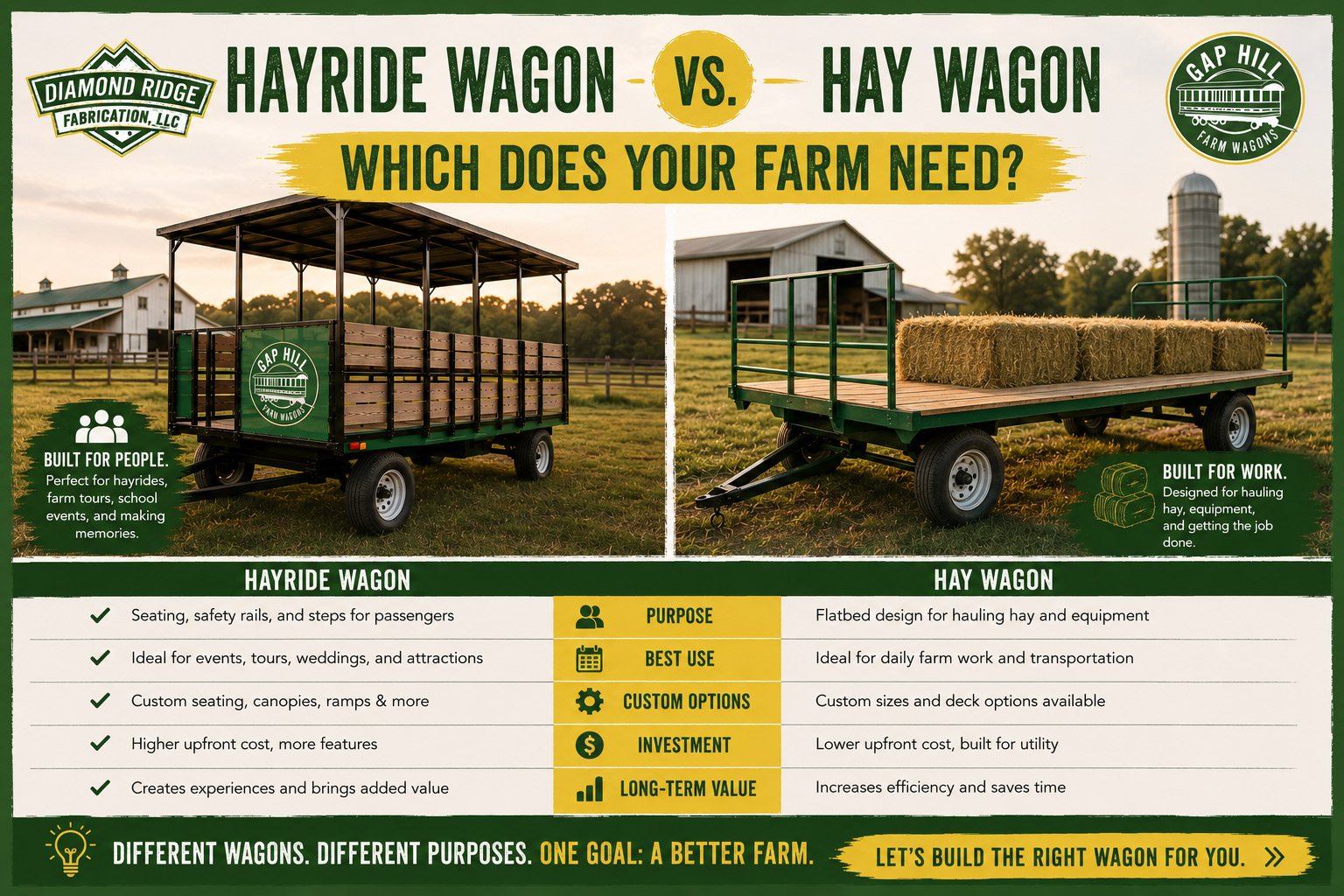
Hayride Wagon vs Hay Wagon: Which Does Your Farm Need?
The names sound similar, but a hayride wagon and a hay wagon are designed for fundamentally different jobs. Buying the wrong one for your primary use case is an easy mistake that costs time, money, and frustration. This guide walks through the key differences between the two, the situations where each one excels, and the questions you should answer before you decide which is right for your farm.
What Is a Hayride Wagon?
A hayride wagon is built first and foremost to carry people safely and comfortably. Its design reflects that priority with features like perimeter railings, bench or padded seating, entry gates or steps, and a smooth, stable ride profile. Safety is the governing design principle. These wagons are common on farms in Gap, Pennsylvania and across Lancaster County that host fall events, pumpkin patch tours, school field trips, and seasonal agritourism experiences. They are designed to be visually appealing, structurally safe, and comfortable enough for passengers of all ages.
What Is a Hay Wagon?
A hay wagon is a work tool. It is designed to handle heavy loads efficiently, which means its design prioritizes load capacity, deck strength, and durability over passenger comfort. Hay wagons typically have flat or low-sided beds, heavy-duty frames, and sturdy axles rated for substantial weight. They are built to be loaded by machinery, driven across farm terrain, and unloaded repeatedly without wear on the structure. Farms that move large volumes of hay, feed, and equipment rely on these wagons as daily workhorses.
A Detailed Comparison
The table below outlines the key differences between hayride wagons and hay wagons across the factors that matter most to farm buyers.
When You Need a Hayride Wagon
A hayride wagon is the right choice when any of the following describe your primary use case.
When You Need a Hay Wagon
A hay wagon is the right choice when the following apply to your operation.
Can One Wagon Do Both Jobs?
Some farms in Gap, Pennsylvania use a single versatile wagon for both light hauling and occasional passenger rides. This is possible if the wagon is designed for it from the start. A hayride wagon with a robust frame and removable seating can double as a utility hauler for lighter loads. However, using a hay wagon to carry passengers is not advisable from a safety standpoint; hay wagons are not designed or rated for the lateral and vertical forces that come with passenger movement.
If dual use is important to you, discuss it explicitly with your builder before ordering. Custom wagon builders in Gap, Pennsylvania can design wagons that balance both needs without compromising safety on the passenger side.
Frequently Asked Questions
Is there a price difference between hayride wagons and hay wagons?
Hayride wagons typically cost more because of the passenger safety features, seating, and finish work required. Hay wagons prioritize structural strength over aesthetics, which can affect pricing in either direction depending on load rating.
Can I convert a hay wagon into a hayride wagon?
It is possible in some cases, but converting a hay wagon to safe passenger use requires adding proper railings, seating, entry systems, and potentially reinforcing the structure. In most cases, buying a properly designed hayride wagon is more cost-effective and safer than conversion.
What load capacity should I look for in a hay wagon?
That depends on your operation. Small farms moving square bales may be fine with a 5,000-pound capacity wagon. Larger operations moving large round bales or heavy equipment may need wagons rated at 10,000 pounds or more.
Do hayride wagons require a different hitch setup than hay wagons?
Not necessarily. Both types typically connect via a standard drawbar hitch. The specific setup depends more on your tractor than on the wagon type.
If I buy a hayride wagon, can I still use it to move light farm materials?
Yes, within the wagon's load rating. A hayride wagon used to move light materials like seed bags, small equipment, or produce is perfectly appropriate as long as you stay within the weight limits and do not overload the deck surface.
Conclusion
The right wagon depends on what your farm actually does. If you carry guests, a hayride wagon built for safety and experience is worth every dollar. If you move hay and equipment, a work-focused hay wagon delivers the durability you need without paying for passenger features you will never use. Gap Hill Farm Wagons builds both types right here in Gap, Pennsylvania and can help you figure out exactly which option fits your operation. Call (717) 442-1097 or request a free quote to talk it through.
