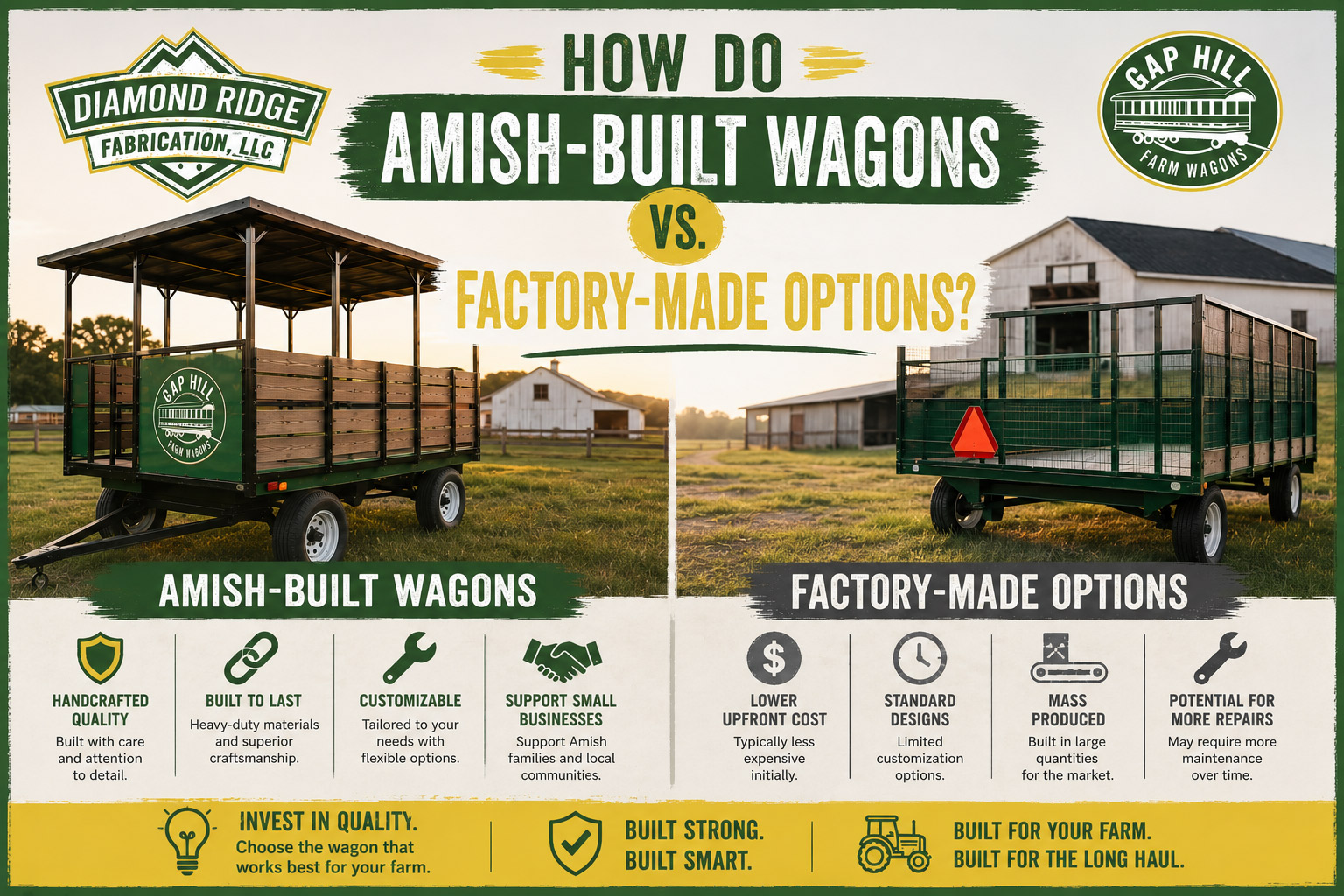
How Do Amish-Built Wagons Compare to Factory-Made Options?
When you start shopping for a farm wagon, you will quickly encounter two very different categories: Amish-built wagons crafted by skilled tradesmen using time-tested methods, and factory-made wagons produced at scale with standardized components. Both get the job done on the surface, but the differences in construction, customization, longevity, and overall value are significant. If you are making a long-term investment in farm equipment, understanding these differences before you buy matters.
A Side-by-Side Comparison
The table below covers the most important dimensions buyers typically evaluate when choosing between Amish-built and factory-made farm wagons.
Where Amish-Built Wagons Have a Clear Advantage
Three areas consistently distinguish Amish-built wagons from their factory counterparts when buyers evaluate them side by side.
Material Quality and Construction Integrity
Amish craftsmen in communities like Gap, Pennsylvania build wagons the same way they have for generations, with careful attention to how pieces fit together, how joints are reinforced, and how materials are selected. A handcrafted weld inspected by the person who made it is fundamentally different from a weld that passes through a quality check station at the end of a production line. Over years of outdoor use, heavy loading, and seasonal temperature changes, those construction differences become visible in how the wagon holds up.
Customization Without Compromise
Factory wagons are designed for the widest possible market, which means their features are chosen to appeal to the average buyer, not your specific operation. An Amish builder in Gap, Pennsylvania can build a wagon to your exact specifications: the length you need for your lane width, the entrance configuration that works with your loading area, the seating layout that fits your typical group size, and the finish that matches your farm's look. That level of fit is simply not available from a manufacturer building thousands of identical units.
Long-Term Cost Efficiency
The upfront price difference between Amish-built and factory wagons is real but often misunderstood. A factory wagon at $5,000 that needs major repairs or replacement in 10 years costs more over 20 years than a $9,000 Amish-built wagon that runs reliably for two decades with minimal maintenance. Buyers across Gap, Pennsylvania who have owned both types consistently report that the Amish-built wagon is the better economic decision when evaluated over the full ownership period.
Where Factory-Made Wagons May Make More Sense
Honesty requires acknowledging that factory wagons are the better choice in some situations. If you need a wagon immediately and cannot wait for a custom build, a factory wagon from inventory solves the timing problem. If your budget is truly fixed at a lower threshold and you only need the wagon for a few seasons, the lower upfront cost may be the right call. And if your needs exactly match a standard configuration offered by a factory, there is less reason to pay for custom work.
What Buyers in Gap, Pennsylvania Typically Choose
Farms in and around Gap, Pennsylvania that make a long-term commitment to agritourism or heavy farm use almost universally opt for Amish-built wagons. The local availability of skilled craftsmen, the ability to inspect build quality in person, and the track record of wagons that have served Lancaster County farms for 20 and 30 years make the decision straightforward for experienced buyers. First-time buyers sometimes start with a factory wagon and upgrade to a custom Amish-built wagon within a few seasons after experiencing the difference firsthand.
Frequently Asked Questions
Can I see examples of Amish-built wagons before I order?
Yes. Most Amish wagon builders welcome shop visits and can show you completed wagons or wagons in progress. Seeing the construction quality firsthand is one of the best ways to evaluate a builder.
Is there a significant difference in how the two types handle heavy loads?
Generally yes. Amish-built wagons are typically engineered with heavier steel and stronger joints, which translates to better performance and safety under heavy loads over time. Factory wagons often have rated capacities that are technically correct but leave less safety margin.
Can factory wagons be repaired locally if something breaks?
It depends on the design. Some factory wagons use proprietary components that require ordering parts from the manufacturer. Amish-built wagons typically use standard steel and lumber that any competent local fabricator can work with.
Are Amish builders insured and do they carry liability coverage?
Reputable Amish builders operate as legitimate businesses and carry appropriate coverage. It is always a fair question to ask any builder, Amish or otherwise, before you place an order.
How do I evaluate an Amish builder I have not worked with before?
Ask for references from past buyers, visit the shop if possible, and ask specifically about what materials they use and how they handle quality issues. A builder with a strong reputation in the community will have no shortage of satisfied customers who can vouch for their work.
Conclusion
For most farms making a serious long-term investment, Amish-built wagons offer a meaningful advantage in materials, customization, and durability that justifies their higher upfront cost. Factory wagons fill a legitimate need for buyers with immediate timelines or fixed budgets, but they rarely match the lifespan and performance of a handcrafted alternative. Gap Hill Farm Wagons has been building Amish-crafted wagons in Gap, Pennsylvania since 1991, and their track record speaks for itself. To see the difference in person or to get a custom quote, call (717) 442-1097.
